

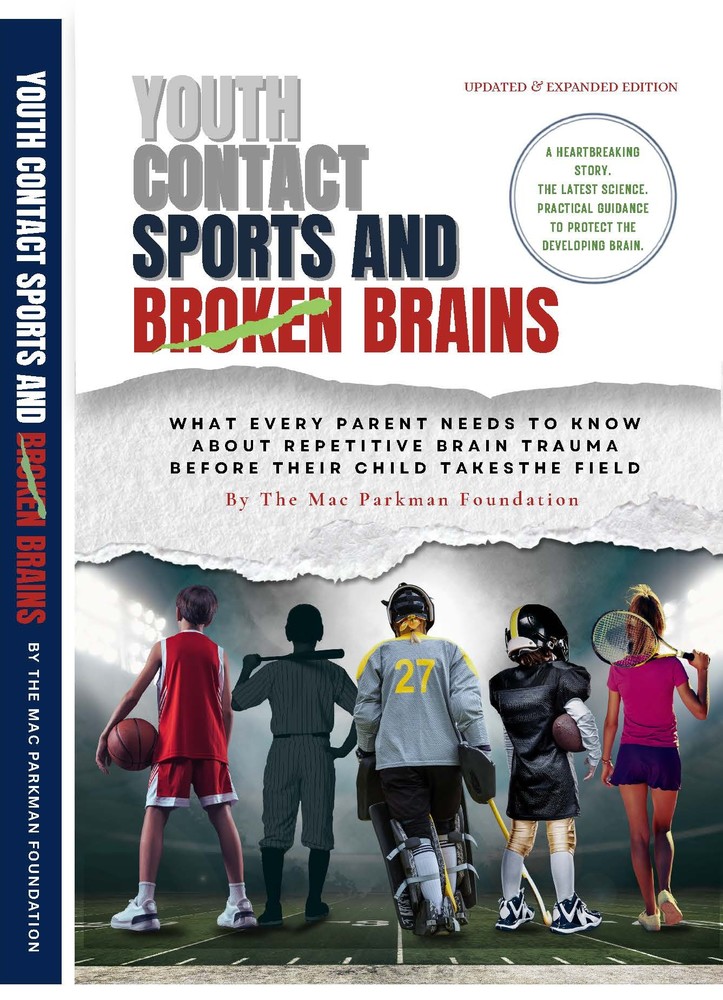
Youth Contact Sports and Broken Brains
What every parent needs to know about repetitive brain trauma before their child takes the field.
A heartbreaking story. The latest science. A practical guide to protecting the developing brain.
A young athlete goes down.
Our knees go weak. We hold our breath.
Finally, the athlete rises. We cheer.
They rub their head, then bravely play on. No damage done.
Or so we think.
Sports-related injuries suffered by young athletes often go unreported and undiagnosed. In Youth Contact Sports and Broken Brains, Bruce Parkman tells the story of his son, Mac, and how repetitive exposure to concussive and subconcussive trauma led him to silently suffer from depression, schizophrenia, and ultimately suicide at the age of 17.
Mac’s story is followed by the science, and by what parents can do about it.
The science has moved forward. So has this book.
Since the first edition, repetitive head impacts (RHI) have become one of the most researched topics in brain health and contact sports. This updated and expanded edition brings that research to parents, and it’s free as an eBook and audiobook.
Two new chapters
Traumatic Encephalopathy Syndrome, the diagnosis that can be made while an athlete is living, and a closing chapter on hope for the future.
Updated research
The science chapters are revised around repetitive head impacts, with new studies on how they affect the developing brain and mental health.
Free, and now an audiobook
Read it or listen in the car and on the sideline. Then pass it to another parent or coach.
That information may have cost me our son, but it is yours as my gift, from one parent to another.
Bruce Parkman, from the new foreword

I want you to know what I know.
As parents, you know the risks your kids face every day: drugs, the internet, video games, strangers. You work diligently and with love to protect them, because you are aware of those risks.
I didn’t know about the risks of concussive and subconcussive trauma that we discuss in this book. I couldn’t protect my son . . . and I lost him.
You don’t want to be in my club. Especially when it is avoidable.
That is why I wrote this book: to share what I’ve learned about the demonstrable link between contact sports, developing brains and mental illness.
Bruce Parkman
What every parent should know
The book doesn’t argue against sports. It argues for knowing what contact does to a brain that’s still developing, and for making decisions with that knowledge.
- 01
The human brain is not designed to handle repetitive trauma.
- 02
Concussive and subconcussive trauma can’t be prevented by helmets or pads.
- 03
Exposing a developing brain to repeated impacts can change its structure, which over time can lead to cognitive and behavioral challenges, including mental illness.
- 04
Damage can’t be accurately assessed at the time, and its impacts may not be seen for years or decades.
- 05
There are non-contact sports and countless athletic activities for kids to enjoy. Let them be kids.
One story. The science. A plan.
Life and death
- 01Mac
- 02Mac’s Last Day
Causes and effects of repetitive head impacts
- 03Understanding the Iceberg
- 04Your Child’s Brain
- 05Brain Development
- 06Understanding Concussive and Subconcussive Trauma
- 07A Young Brain’s Vulnerability to Trauma
- 08Contact Sports, Brain Damage, and Mental Illness
What you can do
- 09What Can Parents Do?
- 10Understanding Total Exposure to RHI: It’s More Than Playing One Sport!
- 11Traumatic Encephalopathy Syndrome: The Live Diagnosis for RHI Exposure New
- 12Hope for the Future New
- 13The Future of Contact Sports (If We Were Santa…)
Plus a new foreword from Bruce, the introduction, and full research references for every chapter.
Read it or listen to it. Both are free.
Pick the format that fits your life. Many parents grab both.
Audiobook
Mac’s story, the science and the guidance, in an accessible audio format.
- Listen on your phone, tablet or computer
- Hear a sample before you download
- Ideal for drives to practice and game day
eBook
The full updated and expanded second edition, ready to read and share.
- Read on your phone, tablet, e-reader or computer
- Easy to share with coaches and other parents
- Keep it on hand for every new season
Downloads are delivered through BookFunnel, which walks you through getting the book onto whatever device you use.
Prefer print? The original first edition is available in paperback on Amazon, and proceeds support the Foundation’s research and education.
A must-read for parents
A must-read for all parents of youth athletes. Bruce Parkman is honoring his son, Mac, by sharing his heartbreaking story and informing parents of the science linking brain trauma and mental illness . . . This book is a gift to parents.
Science is connecting concussions and repetitive head impacts in sports to problems with mental health, and I thank the Parkman family for sharing Mac’s story to educate others that there is a better path with sports participation.

Bruce Parkman has done a great service to begin ringing the warning bell loud and clear about the dangers of concussion, TBI, and their connection to mental health disorders . . . in our youth, adolescent, teenage, and college athletes.

This book is a “must read” for every parent, grandparent, every school board member, every athletic director, trainer, counselor, mental health professional, law maker . . . Now YOU can know.
Bruce Parkman makes the science understandable. He has converted the unimaginable grief over his son’s death into a pertinent, practical guidebook for parents. What an act of courage . . . and love.

This is a must-read for every single parent and healthcare professional . . . Every single time I do an evaluation, I ask about the history of head trauma, concussions, or brain injuries.

Youth Contact Sports and Broken Brains does not discourage sports; on the contrary, it encourages lifelong participation, and embraces our passion for competition.

Read it. Share it. Pass it to a coach.
The conversation has changed. Make sure the people around your kids know what we know now.
The book is free. The work isn’t.
Your gift funds research and education on repetitive brain trauma and mental health for young athletes and veterans.
If you or someone you know is struggling, call or text 988 to reach the Suicide & Crisis Lifeline, available 24/7.