

Florida Proved It Can Be Done.
Florida is home to 1.3 million veterans. In one year, The Mac Parkman Foundation and the Florida Department of Veterans' Affairs built the state's first coordinated model connecting veterans with brain-focused care. Every contract goal was exceeded. Here's what it achieved, and how to get help today.
Every Contract Goal Exceeded
Florida's investment did more than fund treatment. It built a statewide system that finds veterans earlier, trains the people who serve them, and connects each one to the care that fits.
Veterans coordinated into care
3.4× the goal of 100
Of eligible veterans received treatment
81 of the 100 eligible for Foundation-delivered care
Provider & VSO trainings
5.6× the goal of 25
People educated on blast exposure and brain trauma
17.3× the goal of 11,000
Wrap-around referrals
Mental health, family, social and employment support
Veterans & families reached through outreach
43.6× the goal of 55,000
Every coordinated veteran was routed to care
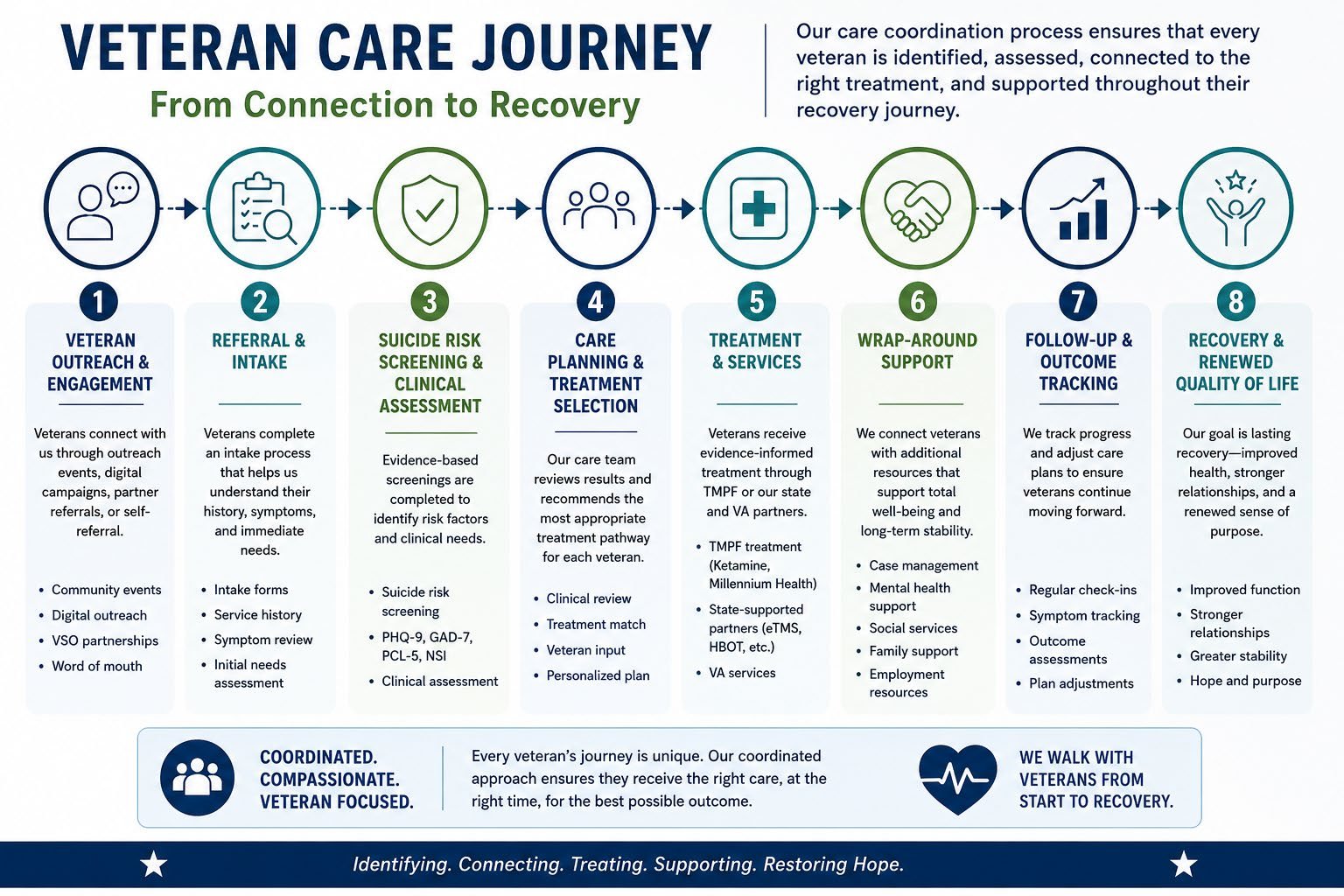
No one who came through the door was left without a next step. Veterans eligible for the Foundation's treatment protocols received them; everyone else was connected to a trusted community, state-supported or VA partner.
Of the 339 veterans coordinated into care, 100 were eligible for Foundation-delivered treatment and 81 received it. The remaining 258 (239 not eligible for Foundation care, plus 19 eligible veterans) were referred to partner providers.
Contract deliverables
| Deliverable | Annual goal | Final outcome | Result |
|---|---|---|---|
| Outreach to veterans & families | 55,000 | 2,399,321 | 43.6× goal |
| Education on RBE & brain trauma | 11,000 | 189,847 | 17.3× goal |
| Veterans coordinated into care | 100 | 339 | 3.4× goal |
| Provider & VSO trainings | 25 | 140 | 5.6× goal |
| Wrap-around referrals | Included in care coordination | 191 | Exceeded |
| Veterans receiving direct treatment | Included in care coordination | 81 | 81% of eligible |
Measurable Improvement Within Four to Six Weeks
Veterans receiving Foundation-delivered treatment reported improvement across the symptoms most often tied to repetitive blast exposure. Providers also reported clinically significant reductions in PTSD and trauma symptom scores.
Self-reported and provider-assessed changes among veterans receiving Foundation-delivered treatment, measured four to six weeks into care. Individual results vary.
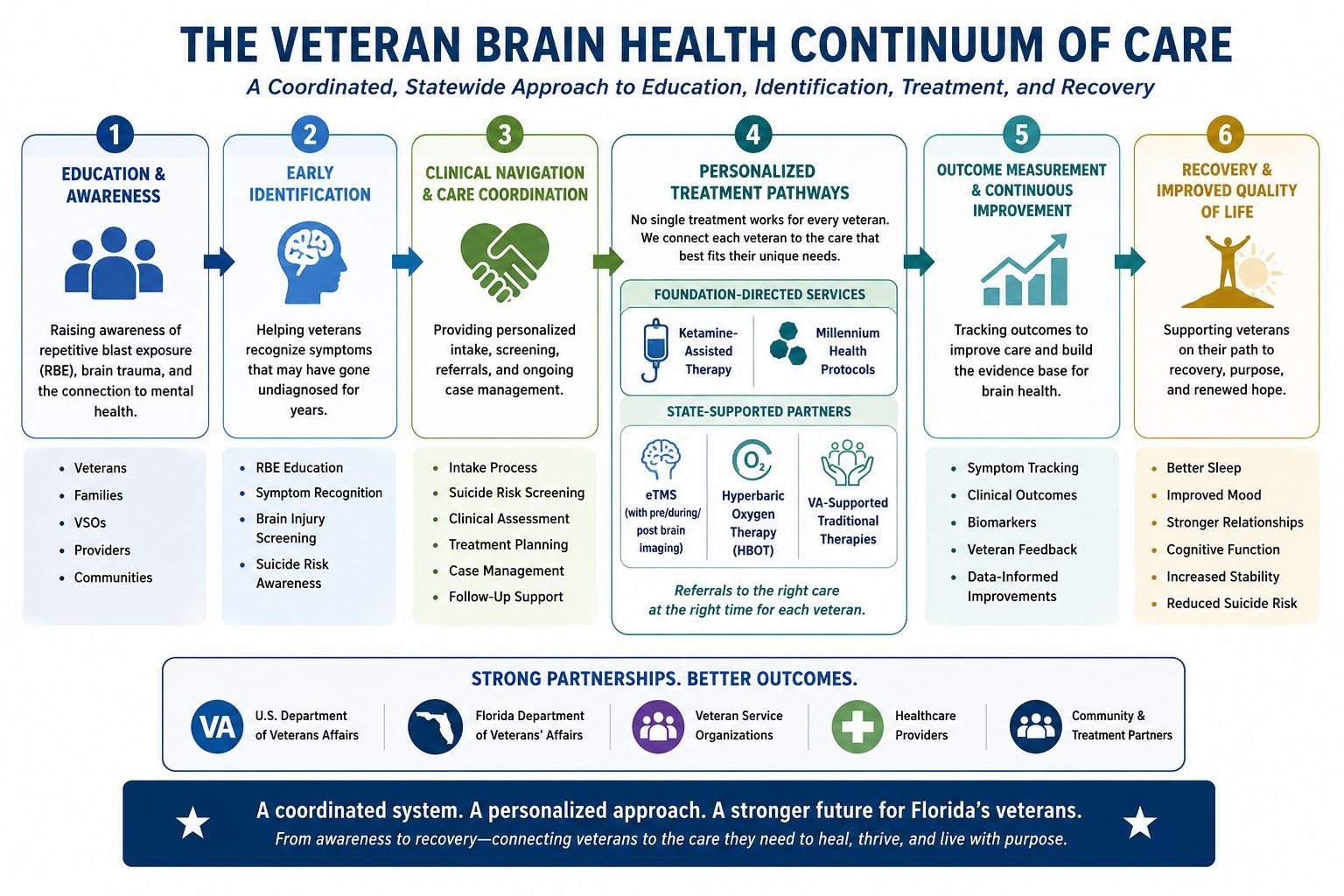
A Coordinated Continuum of Care
Many veterans living with anger, anxiety, depression, sleep disruption or suicidal thoughts are never evaluated for an underlying brain injury. The Florida model was built to close that gap, using five integrated components.
Education & Awareness
Teaching veterans, families, providers and VSOs about blast exposure, brain trauma and treatment options.
Early Identification
Helping veterans recognize symptoms that may have gone undiagnosed for years.
Care Coordination
Intake, suicide risk screening, case management, referrals and ongoing follow-up.
Personalized Treatment
Matching each veteran to Foundation protocols, state-funded partners or VA services.
Outcome Measurement
Tracking clinical results, veteran-reported change and emerging biomarkers.
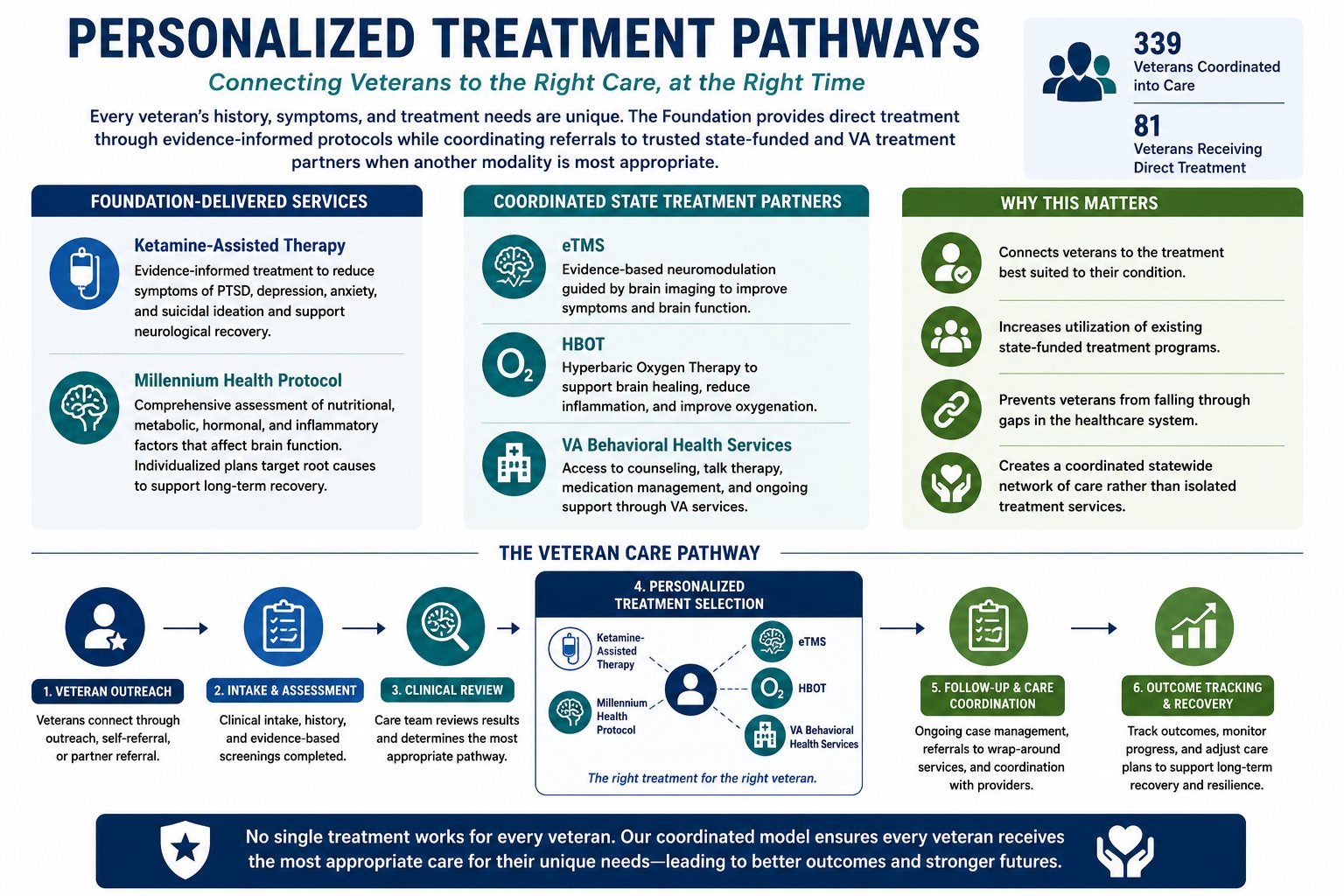
The Right Treatment for the Right Veteran
No single treatment works for every veteran. Every participant received intake, suicide risk screening, care coordination and follow-up, then a treatment pathway matched to their history and goals.
Foundation-delivered services
- Ketamine-assisted therapy to reduce PTSD symptoms, depression and anxiety and support neurological recovery. Learn more
- Millennium Health protocol to identify nutritional, metabolic, hormonal and inflammatory factors affecting brain function, with individualized plans.
Coordinated treatment partners
- eTMS: neuromodulation guided by brain imaging.
- HBOT: hyperbaric oxygen therapy for appropriate candidates.
- VA behavioral health: counseling, talk therapy, medication management and ongoing support.
Advancing precision brain health
The program began integrating inflammatory biomarker analysis through iXpressGenes. Emerging research suggests inflammation may help explain why veterans with similar symptoms respond differently to treatment. Combined with clinical assessments, veteran-reported outcomes and provider observations, it gives a more complete picture of recovery and builds evidence for future care.
Recovery in Their Own Words
"I slept 6 hours without waking last night and felt so rested. I haven't slept more than 4 hours in years."Marine Corps Veteran, Tampa, FL
"Yesterday was my sixth infusion, and the difference has been amazing. It has helped my sleep, behavior, and so much more."U.S. Army Veteran, FL
"I finally have my mom back."Daughter of a veteran, Tampa, FL
"Things that normally would have set me off just didn't anymore. I've already recommended it to several veterans."U.S. Army Veteran
"I cannot believe how great I feel. Have not felt like this in over a decade. I ran for the first time in years."Marine Corps Veteran, Tampa, FL
The Return on Florida's Investment
Total FDVA investment. Every dollar supported contract deliverables while building lasting statewide capacity to identify, educate and connect veterans with care.
What the pilot taught us
- Veterans often live with brain trauma symptoms for years before recognizing the connection.
- No single treatment works for every veteran. Individualized pathways matter.
- Collaboration among nonprofits, the VA, providers and state-funded partners significantly improves access.
- Veterans are more likely to seek treatment once they understand how brain injury and mental health connect.
- Measurable clinical outcomes strengthen future policy, funding and treatment decisions.
- Early identification and coordinated care strengthen long-term recovery.
You Don't Have to Wait for a Program to Get Help.
While the pilot isn't enrolling, the network it built is still here. During the program we worked alongside VA services, state-supported treatment providers and veteran service organizations across Florida. Start with the resources below, or ask us to point you to the right one.
If you or a veteran you know is in crisis
Call 988 and press 1, text 838255, or chat at VeteransCrisisLine.net. Free, confidential, 24/7. You don't need to be enrolled in VA benefits or health care.
VA health care
Enrolling gives access to VA behavioral health, TBI evaluation and treatment programs. How to apply for VA health care
Florida Department of Veterans' Affairs
State benefits and your local County Veteran Service Officer, who can help with claims and connect you to local services. FloridaVets.org
Ask us for a referral
The Mac Parkman Foundation doesn't provide medical care directly, but we can connect you with trusted partners from our Florida network. Request a referral
Help Bring the Florida Program Back in 2027.
We've asked the State of Florida to fund a second year. Funding isn't guaranteed, but the results make a strong case, and so does knowing how many veterans are waiting. Join the list below and you'll be first to know if the program reopens.
Providers, VSOs and Community Organizations: Let's Keep Building.
The pilot proved what a coordinated network can do. If you're a Florida-based healthcare provider, VSO or community organization serving veterans, we want to partner with you to grow that network, advocate for brain health policy at the state level, and put practical tools in veterans' hands.
Our Brain Health Readiness Toolkit, including pocket symptom cards and family discussion guides built around one message, "You maintain your weapon. Maintain your brain.", is in development for partners to distribute.
Thank You to the Florida Department of Veterans' Affairs
This pilot was made possible through a partnership with FDVA, alongside the U.S. Department of Veterans Affairs, Veteran Service Organizations, healthcare providers and community treatment partners across Florida. Together, we showed that when veterans are connected to the right care at the right time, recovery is possible.